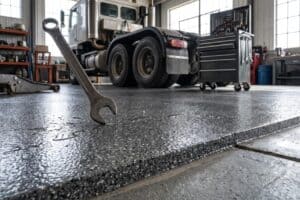





A dropped torque wrench sounds harmless until it leaves a crater in the slab. Garages and workshops take far more punishment than most people plan for, from jack stands and engine hoists to lathes bolted straight to the floor. Thickness is what separates a coating that survives that abuse from one that peels within a year.
What Actually Happens to Bare Concrete Under Heavy Equipment?
Bare concrete looks tough, yet it is porous and brittle at the surface. Point loads from a floor jack or the legs of a heavy workbench concentrate thousands of pounds into a few square inches, and that pressure chips edges and creates hairline cracks. Dragging a tool chest across the slab grinds the surface into dust.
Dust matters more than it seems. Loose concrete particles settle on tools, tires, and finished projects, and they signal that the top layer is breaking down. A thick garage floor coating seals that layer and gives the slab a hard, continuous skin to carry the load.
How Thick Does an Epoxy Garage Floor Need to Be?
Thin, roll-on kits often lay down just two to three mils, about the thickness of a sheet of paper. That film can look glossy on day one, but it has little mass to absorb a hit. Systems built for real workloads run much heavier, commonly 20 mils or more, and some reach a quarter inch when broadcast with quartz or aggregate.
Layers do different jobs. A primer soaks into the concrete for adhesion, a build coat adds body, and a topcoat handles chemical and scratch resistance. Skipping the build coat is the shortcut that most often leads to early failure.
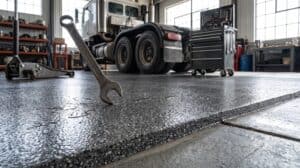
Why Do Dropped Tools Crack Thin Coatings but Not Thick Ones?
Impact force has to go somewhere. A wrench hitting a thin film transfers energy straight into the brittle slab beneath, and the coating chips around the point of contact. Those chips become entry points for moisture and oil, which then creep under the film and lift it.
Thicker systems spread and dampen that energy across more material. Some include flexible polyurea or polyaspartic topcoats, which bend slightly instead of shattering. Hammers, sockets, and brake rotors still leave marks occasionally, but the damage stays cosmetic rather than structural.
Does Hot-Tire Pickup Ruin Thin Epoxy Flooring?
It does, and heavy machinery makes the problem worse. Tires hold heat after a drive, and that warmth can soften a poorly cured or low-grade coating. The rubber then pulls at the surface as the vehicle sits, leaving ghost marks or peeling patches.
Quality epoxy flooring cures into a dense, cross-linked film that resists this softening. Moisture is another hidden culprit, since vapor pushing up through the slab can bubble the coating from below. A simple calcium chloride or relative humidity test before application reveals whether a moisture barrier is needed.
Why Does Surface Prep Decide Whether Thickness Even Matters?
Heavy coating on a poorly prepared slab simply fails in a heavier sheet. Diamond grinding opens the pores of the concrete so the primer can bond mechanically, which acid etching and light sanding rarely achieve. Cracks and spalls get filled with a rigid repair material before the first coat goes down.
Temperature and humidity during installation also affect curing. Applying product on a cold or damp slab can cloud the finish and weaken the bond. Professional crews monitor those conditions and follow cure times, which is why a rushed weekend job rarely matches a planned installation.
What Should Owners Look for in Epoxy Flooring Companies?
Quotes should state the system in writing, including mils of thickness, number of coats, primer type, and topcoat chemistry. Anyone searching for an epoxy floor company near me will find plenty of options, so comparing grinding methods, moisture testing, and warranty terms separates serious installers from quick-turnaround ones. Photos of garages that have seen several years of use reveal more than glossy before-and-after shots.
Warranty details deserve a close read. Coverage for peeling, delamination, and hot-tire pickup differs widely between epoxy flooring companies, and vague language usually works against the customer. Questions about cure time before parking a vehicle or rolling a toolbox back on also expose how thorough an installer really is.
Where Can Shops and Large Facilities Get a Coating Built for Real Abuse?
Workshops, equipment bays, and industrial garages push coatings harder than any home setup. Forklifts, pallet jacks, chemical spills, and constant foot traffic call for systems engineered around those demands. For garages, workshops, and demanding commercial or industrial spaces, Pros LLC handles floor preparation, epoxy systems, protective coatings, and other heavy-duty flooring applications. Its services can be tailored around equipment weight, impact risk, rolling traffic, chemical exposure, and maintenance demands so the finished floor is built for the conditions it will face every day.